Guide
Hail, wind, and what is behind the panels: siding repair or replacement
A storm just went through and you are looking at your walls. Here is how to read what you see, and why the wall behind the siding is the bigger question.
5.0 across 25 Google reviews · Licensed & insured · BBB Accredited, rated A · TimberTech PRO Gold contractor

After a hailstorm or a night of straight-line wind, the first thing you notice is usually the obvious thing: a cracked panel by the back door, a strip of siding flapping at a corner, a row of dents on the side that faced the storm. That damage is real, and it is also the easy part. Siding is a replaceable skin. What it protects, the sheathing, the house wrap, the flashing around every opening, is the part that decides whether a storm costs you a few panels or a wall.
This guide walks through how storm damage reads on each common siding material, what to look for behind it, how the call between repair and replacement actually gets made, and what matching, insurance paperwork, and the building season do to the plan. It does not name a product for your house. That depends on what is on the wall now and what is under it, and nobody can see that from a driveway. It goes a level deeper than our page on siding repair and replacement around Sioux Falls.
Every siding material shows hail and wind differently
Hail and wind leave different fingerprints on different materials. Hail hits the faces of the walls that faced the storm. Wind works the edges: laps, corners, the ends of runs, and anything already loose.
- Vinyl: cracks, punched holes, and chips along the bottom edge of a lap. Wind unlocks panels so they lift or pull off, often starting at a corner. Vinyl that has gone brittle with age cracks where newer panels would flex.
- Fiber cement: chipped faces, cracked corners, and broken bottom edges rather than dents. A chip that breaks the paint lets the board take on water.
- Engineered wood: dents and scuffs in the finish. Where the finish breaks at a cut edge, the board can take on water and swell there.
- Steel: dents and chipped coating. A dent is cosmetic until the coating breaks; then the metal can rust.
- Wood: splits, checks, bruised grain, and paint knocked off in spatter marks. Bare wood left through a wet spring weathers and rots at the damage.
- Aluminum: dents that show in low sunlight and hide at noon. Aluminum dents easily and does not spring back.
How to look at your own walls after a storm
Walk the whole house, not only the wall you noticed, starting on the side the storm came from. Look in low, raking light, early morning or late afternoon, when dents and lifted laps throw shadows. Check the soft metal near the siding too: gutters, downspouts, window wrap, and the fins on the air conditioner. Dents there show how hard and from which direction the hail came.
For wind, look along the bottom of each lap for panels that sit proud of the one below, check corners and run ends, and look for pieces in the yard. Photograph every elevation, close and wide, before anything gets patched. Stay off the ladder if you are not comfortable on it; photos from the ground are enough to start.
The damage you can see is the smaller question
A cracked panel is a hole in the skin. What matters is whether water got past it, and whether water was getting past that wall before the storm arrived. Behind the siding sits house wrap or building paper, the sheathing it is fastened over, and the framing. The wrap sheds whatever gets past the siding, but only if it is continuous, lapped the right direction, and tied into the flashing at every opening.
Water that has been getting in for a while leaves evidence. Outside: siding that is wavy or bowed, trim that is soft when you press it, staining that runs down from window corners. Inside: paint bubbling or drywall staining under windows, a musty smell in one room, swollen baseboard. None of those prove the sheathing is wet, but any of them is a reason to open the wall before anyone orders material.
Where water actually gets in: windows, doors, and the deck ledger
Water rarely gets into a wall through the middle of a panel. It gets in at the details. The head of a window or door needs flashing that sends water out over the siding, not behind it. The sill needs to be sloped and flashed. Where a roof meets a sidewall, the flashing at the bottom of that run has to kick water away from the wall, or it pours down behind the siding every time it rains.
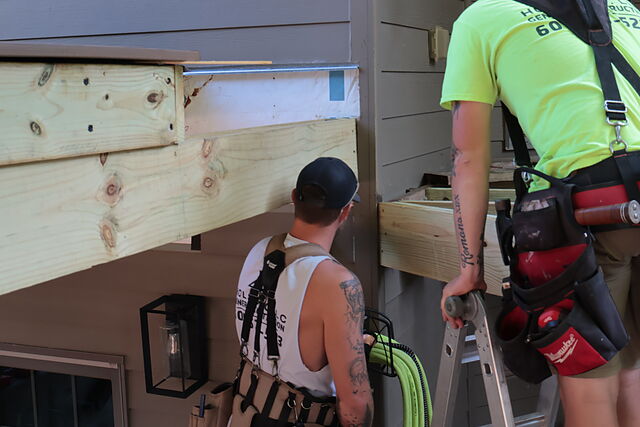
The deck ledger is the other common failure. If the board a deck hangs from was never flashed, water runs down the wall, sits behind the ledger, and rots the rim joist and sheathing around it. You often cannot see it until the siding comes off, which is exactly why a siding job near a ledger is the moment to look.

How the repair-or-replace call gets made
Isolated damage on a sound wall is a repair. A few cracked vinyl panels, a lifted run at a corner, a chipped board or two: if the material around them is still flexible and the sheathing behind is dry, the damaged pieces come out, the wrap gets checked and patched, and new pieces go in.
The call changes when the wall tells you the problem is not the storm. Panels that crack when you remove them to reach the damage are brittle across the elevation, and every repair will break more of them. Moisture in the sheathing means the wrap or the flashing has failed, and patching the siding over it only hides the damage. A wall that fails after every storm usually points to fastening or wrap, not bad luck. In those cases replacing the elevation, or the house, is the repair that holds. Jace makes the call on the walkthrough with the siding in front of him, and the written estimate says which one and why.
Want this worked out for your own build? Jace writes the estimate on site — no call center, no obligation.
Matching old siding is harder than it sounds
A repair only looks like a repair if the new piece matches. Profiles get discontinued, textures and exposures change, and colors that were available when your house was sided may not be now. Even when the exact product is still made, your panels have faded in the sun, so a new one from the same line can look like a patch.
There are honest ways around it. Pieces can sometimes be borrowed from a protected wall, such as behind a deck, with the new material going where it will be seen less. A repair can run to an inside corner so the change reads as intentional. Painted materials can be repainted. And sometimes no match exists and a full elevation has to be re-sided to look right. Ask any contractor, in writing, how they intend to match and what the fallback is.
What an insurance claim needs from the contractor
We do not tell you what your insurer will pay or how your policy reads. That is between you, your agent, and the adjuster. What a contractor can give you is documentation: a written estimate built from an in-person walkthrough, covering the whole exterior and not only the wall you noticed. A scope that leaves out the trim, gutters, and window wrap on the storm side is not a full record.
A useful estimate names the damage by elevation, notes the material and profile, says whether a match is available, and separates storm damage from conditions that were there before, like rotten trim or an unflashed ledger. That separation matters. Mixing old problems into a storm claim is not honest, and leaving storm damage off because nobody looked is not in your interest either. Keep your own photos alongside it.
The short season, and why some siding should wait for warmer weather
The building season here is short, and storm damage tends to arrive in the middle of it, when crews are already booked. Get the walkthrough and written scope done soon after the storm, even if the work is scheduled later, and protect open damage in the meantime so the wall stays dry.
Some materials should not go on in hard cold. Vinyl gets brittle and can crack when it is cut or nailed cold, and it has to be hung with room to move as it warms. Paint, caulk, and sealants carry minimum application temperatures on the label. The manufacturer's installation instructions set those conditions for each product. Emergency repairs can happen in any weather; a full re-side is worth scheduling into conditions the product was made for.
A re-side is the natural moment to fix what is around the siding
With the siding off, the wall is open in a way it will not be again for a long time, and the work around it is simpler to do right. Rotten trim at sills and corners gets replaced instead of caulked over. A ledger that was never flashed gets flashed. Missing or reversed window flashing gets redone.
Look at the ground too. Grading that slopes toward the house, or a downspout that dumps at the foundation, splashes water up the bottom of the wall every rain. Whether any of this connected work needs a permit is set by the building department for your address; when it does, we pull it in our name. More on that is on our licensed general contractor page.
What the walkthrough covers, and how to set one up
Jace walks the whole exterior in person: every elevation, the trim, the gutters and downspouts, the window and door details, any deck ledger, and the grade along the foundation. Where there is reason to, he looks behind the damage before recommending anything. He tells you what he would put on the house and why, and whether a repair will hold or the wall needs more. The lines we offer include James Hardie fiber cement siding and trim and AZEK PVC trim and siding, and the estimate prices the material that fits your house. The written estimate that follows names the product, lists the scope by elevation, separates storm damage from existing conditions, marks any allowances, and lists exclusions. It is a number and an exact scope, not a range that moves.
If your walls took a storm, call or text (605) 679-5223 to get on the schedule.


