Guide
Repair or replace: how to read an aging deck
The boards are what you look at. The frame is what you are deciding about. Here is how to read both from the yard before anyone quotes you.
5.0 across 25 Google reviews · Licensed & insured · BBB Accredited, rated A · TimberTech PRO Gold contractor

An aging deck sends mixed signals. A board gives underfoot, the railing moves when you lean on it, the ends have split. Some of that is cosmetic and some of it is the structure telling you it is done, and from the patio door the two look alike. The question is not how old the deck is or how bad it looks. The question is whether the part underneath can carry another round of decking.
This guide walks through where decks fail in a freeze-thaw climate, how to spot each failure from the yard, and the rules our deck builders in Sioux Falls use to decide when a repair makes sense and when it is money spent twice. There are no prices here. What is here is the test that decides which job you have.
The boards are the surface; the frame is the deck
Split the deck in two. The walking surface and the railing are the parts you touch and the parts that wear: boards split, stain fails, fasteners back out, balusters loosen. All of it can be replaced without touching anything structural. Underneath is the actual deck: the ledger that ties it to the house, the joists that carry the boards, the beams that carry the joists, the posts that carry the beams, and the footings that carry everything into the ground.
That split is the whole decision. A tired surface on a sound frame is a repair or a resurface. A failing frame under any surface, new or old, is a replacement, because boards fastened to a bad frame inherit every problem it has. Read the surface for comfort and looks, and read the frame for whether it gets to stay.

The ledger is where attached decks fail first
On an attached deck, the ledger board is fastened to the rim joist of the house, and that joint carries a large share of the deck. It is also where water wants to go. If the ledger was never flashed, or the flashing was cut short or tucked in the wrong direction, rain and snowmelt run down the siding, get behind the ledger, and sit against the rim joist. Wood that stays wet rots where nobody looks.
From the yard, look at the joint between the ledger and the house. Dark staining on the siding or foundation below it, soft or crumbling wood at the ledger face, rust streaks from the fasteners, and a visible gap that has opened between the ledger and the wall are all signs worth taking seriously. From a basement, look at the rim joist behind the deck for staining or soft wood. A ledger that looks like it was held on with nails alone, rather than bolts or structural screws, is its own flag. A deck pulling away from the house is the one sign on this page that should change how you use the deck today.

Frost-heaved footings show up in the railings and stairs
Footings that stop above the frost line get lifted by frozen soil each winter and do not always settle back. The frame racks, and the movement shows up in the parts that are supposed to be straight.
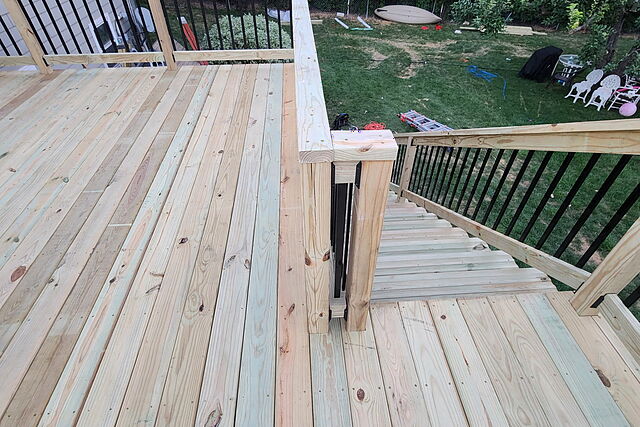
Stand back and look. Railing posts that lean out of plumb, a stair stringer that has pulled away from the rim it hangs from, a stair that now lands on a slant, a gap that opens and closes at the house with the seasons, and a walking surface where water pools in one spot or a marble would roll are all consistent with footings that moved. Look at the posts where they meet the ground for footings that have tipped, cracked, or risen above grade. Precast blocks sitting on the surface were never below the frost line at all.

Posts rot at grade, joists rot at the ends
Wood decays where water sits against it. Posts buried in soil or set in concrete that holds water rot at the ground line, often from the inside, while the part above grade looks fine. Joists rot at their ends against the ledger and the beam, and along the top edge where boards trap moisture and debris. Stair stringers rot at the bottom where they sit on the ground or a pad.
A screwdriver is the tool here. Push it into the wood at those spots: sound pressure-treated lumber resists, rotten wood lets the tip sink in with little effort or pulls out in wet fibers. One soft spot is a repair conversation. Soft wood at several joist ends, or rot in the ledger and the posts together, says the frame has been wet for a long time.
Loose rails are sometimes hardware and sometimes framing
A railing that moves is one of the more serious complaints on an older deck, because the guard is the part people lean on above a drop. Sometimes the fix is simple: backed-out fasteners, a split baluster, a loose rail joint. Sometimes the post itself was notched and lag-screwed to the outside of the rim with nothing behind it, and it moves because there is no blocking to resist the lean. That is a framing problem wearing a railing's clothes.
Grab each post near the top and push outward. Movement at the rail joint is hardware. Movement where the post meets the rim, or a rim that twists when the post moves, means the connection has to be rebuilt inside the frame. On a deck being resurfaced anyway, that is the time to do it.
Want this worked out for your own build? Jace writes the estimate on site — no call center, no obligation.
Cupped and split boards are a surface problem, most of the time
Board damage looks alarming and is usually the least structural thing on the deck. Boards cup as moisture moves through them unevenly, split at the ends through freeze-thaw and hard sun, and lift as fasteners back out. Those are reasons to resurface, not to tear down.
The exceptions are worth knowing. A board that feels spongy between joists can mean the joist under it has gone soft along the top edge. Boards that sag in a line can mean the joists were spaced too far apart for the decking, which matters if you are thinking of switching to composite, since composite and PVC boards each come with the manufacturer's own spacing requirement that the existing frame may or may not meet. And a deck where you are replacing boards every spring is usually telling you about the frame underneath, not the boards.
The decision rules, stated plainly
Once the frame has been read, the call is usually not close. These are the rules we work from, and you can hold any bidder to them.
- Sound frame, tired boards: resurface, and re-rail if the guard is loose or dated
- Sound frame, too small for how you use it: extend it, tying new framing into the old
- Isolated rot in a few joists or a post: repair it, then decide on the surface
- Failed ledger, rot behind it, or a deck pulling off the house: replace
- Heaved, shallow, or missing footings under most of the deck: replace
- Rot spread through joists, beams, and posts: replace
- Frame that will not meet the spacing your new decking needs: replace or reframe
What a real repair includes, and when it stops making sense
Repair is not only swapping boards. Structural repair is framing work, and framing is core work for us. On a deck it can mean sistering a new joist alongside one that has gone soft, replacing a rotted post, correcting an undersized or settled footing so the post above it sits on something below the frost line, pulling siding to re-flash a ledger that was never flashed properly, and rebuilding stairs from new stringers up. We check the rim joist before anything gets bolted back to it, and anything we find behind the siding at the rim joist or sill plate gets its own line on the estimate rather than being buried.
Repair stops making sense when the list gets long. If the ledger, the footings, and a good share of the joists all need work, you are rebuilding a deck one piece at a time while keeping the parts of the old design you did not like. At that point replacement is the better use of the money, and we will say so. Why the numbers land where they do is covered in what drives the cost of a deck.

A replacement is a chance to change what you did not like
Tearing down a failed deck resets every decision the first builder made. The height can change to line up with the door. The shape can change: a wider section for a table, a smaller footprint where nothing ever happened, stairs that come down where you actually walk. The frame can be attached to the house on a properly flashed ledger, or built free-standing where the house will not take the load. The surface can move from wood to composite or PVC, and the railing can change too.
The structure gets built for this climate either way: footings below the frost line, a flashed ledger, and the same frame whether wood or a composite line goes on top. That is the point of replacing: the part you will never look at again is the part that gets done over.

Permits, and what the walkthrough checks
Replacing a deck, and structural repair on one, is work the building department for your address generally wants to see, and the rules are not the same everywhere in the Sioux Empire. The department that has jurisdiction over your property sets what needs a permit and what gets inspected. We pull the permit in our own name and schedule the inspections whether your address falls under a city or the county, and any quote you get should say in writing who is pulling it.
The walkthrough is where the frame test actually happens. Jace gets under the deck if there is a way under it, probes the posts and joist ends, looks at how the ledger meets the house and whether it was flashed, and checks the footings and the stairs for movement. Then he tells you which job you have, repair, extension, or replacement, and the written estimate describes exactly that scope, with exclusions listed and allowances marked. Call or text (605) 679-5223 to set one up.


