Guide
Cable, aluminum, composite, or wood: choosing a deck railing you will not regret
The railing is the part of the deck you look through, lean on, and hold on the way down the stairs. Here is what each system actually asks of you, and what stays the same no matter which one you pick.
5.0 across 25 Google reviews · Licensed & insured · BBB Accredited, rated A · TimberTech PRO Gold contractor

Railing gets picked last. The footprint gets settled, the boards get chosen, the stairs get laid out, and then somebody asks what goes around the edge. That order is backwards for a decision this visible. From inside the house you see the railing before you see the deck. It sits between your chair and the view, it is what your hand finds at the top of the stairs, and it takes wind, sun, and drifted snow standing up instead of lying flat.
Railing is part of every job our deck builders in the Sioux Falls area quote, and it is its own decision, separate from the boards. This guide is about choosing the system: wood, aluminum, composite or PVC, cable, glass, and the wood and black metal mix you see on a lot of decks around here. It does not repeat how the safety details get built. For post attachment, guard openings, stair layout, and permits, read our guide to how deck railings and stairs get built safely.
The railing decides four things you live with every day
The first is the view. A railing is a screen with holes in it, and what fills the holes decides what you see from a chair. Thick wood balusters close the view down, thin metal ones open it, and cable and glass come closest to taking the railing out of the picture.
The second is upkeep: some systems ask for a brush and a finish, some for a hose, some for a wrench. The third is how it feels under a hand. Wood is warm and a little rough, metal gets hot in July and cold in January, and a composite top rail sits between. The fourth is how it ages. A railing stands in the sun on every side, collects snow at its base, and takes straight-line prairie wind broadside. Each material answers that differently.
The code does not care which system you pick
Guard height, the size of the openings, and the load a guard has to resist are set by the building code your jurisdiction has adopted, and they are the same rules for wood as for cable. We do not print the figures because they vary between jurisdictions and get revised. The inspector checks against the code adopted for your address and, on a manufactured system, the maker's published installation instructions for the parts actually purchased.
The practical consequence: the code does not rank one system above another. A cable railing built to its instructions and a wood railing built to code both pass, and either one fails if the posts are loose or the openings are wrong. Compare systems on view, upkeep, feel, and aging. Compare bidders on whether they build the one you picked to the rules that apply.
Wood posts and rails: warm, repairable, and never finished for good
A wood railing is built on site from pressure-treated or cedar stock, and that gives it two real advantages. It can be shaped to the house: a wide flat cap you can set a drink on, a top rail that echoes the trim. And it can be repaired one piece at a time. A split baluster is one board to replace, not a call to a manufacturer about a discontinued color.
The cost is upkeep and movement. The freeze-thaw cycle that checks deck boards checks railing parts too, and a railing stands upright where the sun hits both sides. It needs a finish, renewed on the cadence the finish manufacturer calls for, and the top rail and the south and west runs ask for it first. Balusters can twist and caps can cup as the wood moves. That is not a defect. It is wood.
Wood posts with black metal balusters is the common mix here
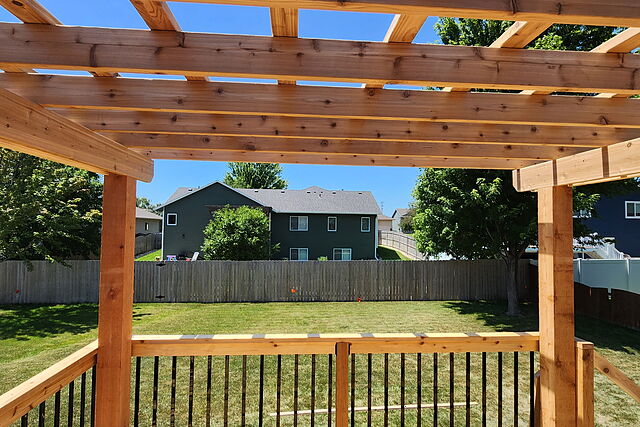
Wood posts, a wood top and bottom rail, and black metal balusters between them: it is a familiar look on decks in the Sioux Falls area, and you can see it on the decks photographed on this page. It splits the job sensibly. The wood gives you a warm top rail and a structure that can be built and repaired on site. The metal balusters are thinner than wood, so the view opens up, and they come factory-coated, so the part with the most surfaces to paint is the part you never paint.
The trade is that you still own a wood railing, with the same finish schedule on the posts and rails. Ask how the balusters are held, whether in drilled holes, on connectors, or through a baluster rail. Each works, and each looks a little different up close.

Aluminum: finished at the factory, limited in the palette
An aluminum railing arrives powder-coated and cut to a system of posts, rails, balusters, and brackets that fit together a specific way. It does not rust, the coating needs no stain or sealer, and the parts are light. For an owner who wants the railing done the day it goes in, that is the draw.
The limits come in the same box. Colors and profiles come from the maker's list, and the look reads as a manufactured product rather than something built for the house. A scratch through the coating is a touch-up, not a sanding job. A metal top rail is also cold in winter and hot in direct sun, which matters on a south-facing deck where people lean. Some systems accept a wood or composite cap for exactly that reason.
Want this worked out for your own build? Jace writes the estimate on site — no call center, no obligation.
Composite and PVC railing is built to match the boards
Composite and PVC railing systems come from the same manufacturers that make the decking, and the point is the match: rail, cap, and post sleeve colors designed to sit next to the boards. They need no finish, clean with soap and water, and look more substantial than aluminum. Trex, Fiberon, Deckorators, and TimberTech all sell railing. The coverage on any of them comes from the manufacturer, not the builder, so read the published terms for the exact line. These systems go together the maker's way, a sleeve over a structural post or the maker's own post and bracket hardware, to its published instructions, because that is what the inspection and the warranty both come back to.
On a TimberTech deck the railing touches one more thing. Hols & Co is a TimberTech PRO Gold contractor, and TimberTech's labor warranty, which is not a workmanship warranty, runs a longer term when the deck carries a full TimberTech railing system. A partial kit or another brand's rail keeps the shorter term. The full terms and their conditions are on our TimberTech PRO page.
Cable railing buys the view with tension and stiff posts
Cable railing runs thin metal cables horizontally between posts, and short of glass nothing opens the view further. On a deck that looks over a field or a pond, that is the whole argument.
The engineering is less obvious. Every cable is pulled tight, and that tension lands on the end and corner posts, which are pulling inward all day. Those posts have to be stiff enough not to bow, on a frame solid enough not to rack. Cables stretch and settle, and temperature swings change them, so tension gets checked and adjusted over the life of the railing; a slack cable can open a gap the code does not allow. There is also more hardware than any other system, all of it installed to the maker's instructions. The cold does not bother the hardware, but a frame that moves with frost shows up in a cable railing first.
Glass panels give the widest view and ask for the most cleaning
Glass panels set between posts or in a base channel take the railing out of the sightline entirely, and they block wind at seated height, which on an exposed lot can make a deck usable on days it otherwise would not be.
The costs are practical. Glass shows water spots, pollen, and dust on both sides, and a deck facing open country will need its panels cleaned far more than any other railing needs attention. A glass wall also catches wind as a full load instead of letting it pass, so the posts and their connection to the frame carry more. Glass systems have their own published installation requirements, and those govern the build.
Every system is only as good as the post it hangs on
Whatever you choose, the posts attach to the deck frame, never to the decking. A post screwed down through the boards can stand straight and still let go under a lean, and a composite sleeve or an aluminum post still depends on what is under it. The railings and stairs guide linked above covers how that connection gets built.
Stairs are part of the decision too. The guard along an open side and the handrail you hold are different things, and the handrail has to be graspable, something a hand can close around. A wide flat cap may look right on the deck and still fail as a stair handrail, which is why many systems offer a separate handrail profile. Whether a stair needs a handrail on one side or both is set by the code for your address and confirmed at inspection.
Match the house, then get it all in writing
A railing that matches the boards and fights the house still looks wrong. Look at the window frames, the trim, and any metal already on the house before you open a sample chart, then check rail and board samples side by side outside in daylight. Every bidder should name, on paper, the items listed at the end of this section.
Jace walks the site, looks at the view from inside the house, and writes the estimate with the railing named by product and color, the post attachment spelled out, and the stairs described. The same crew builds it, and the permit goes in our name. To walk your deck before anything is ordered, call or text (605) 679-5223.
- The railing system by manufacturer, product line, and color
- How the posts attach to the frame, and with what hardware
- Whether the stairs and every landing are railed, and on which sides
- The stair handrail profile
- Who pulls the permit and schedules the inspection


