Guide
Foundation cracks, sloping floors, and sticking doors: which ones matter
A crack tells you something by its direction, its shape, and whether it is changing. Here is how to read one before you decide whether to worry.
5.0 across 25 Google reviews · Licensed & insured · BBB Accredited, rated A · TimberTech PRO Gold contractor

You found a crack in the basement wall, or a door upstairs stopped latching, and now you are wondering what it means for the house. The short answer is that a crack by itself tells you less than people fear and more than people assume. Poured concrete cracks as it cures, and houses in this part of South Dakota go through freeze-thaw every winter. Some of what you see is the house being a house. Some of it is a wall carrying a load it was not built to carry. The difference is readable, and you can do a lot of the reading yourself.
This guide covers how to read a crack by its direction and pattern, how to tell a crack from movement, which settling signs show up upstairs long before anyone looks at the foundation, and why water sits behind most of it here. It also draws the line between what a general contractor repairs and what belongs to a specialty trade or an engineer. What we take on is on our foundation and structural repair page; this one is about what to look at, and what to do first.
Direction is the first thing a crack tells you
Start by noting which way the crack runs, because direction points at the force that made it. A vertical hairline crack in a poured wall, running from the top down or from the floor up, is usually shrinkage from the original cure. On its own, dry and unchanging, it is usually cosmetic.
A horizontal crack is a different signal. It runs along the length of the wall, often partway up, and it means the wall is being pushed from the outside: saturated soil leaning on it in a wet spring, or frozen ground pressing in. If it keeps going, the wall starts to bow inward along that line. Hold a long straightedge or a taut string along the wall. If it is no longer flat where the crack runs, have it looked at soon rather than eventually.
Block foundations crack in stair-steps, and openings crack from the corners
Concrete block walls do not crack like poured walls, because the mortar joints are the weak line. When a block wall moves, the crack follows the joints and climbs in a stair-step pattern, block by block. Near a corner, it often points at one end of the wall settling. Across the middle of a long wall, paired with a horizontal joint crack, it can mean the same side pressure that bows a poured wall.
Diagonal cracks that start at the corner of a basement window or a door opening are their own category. An opening concentrates stress at its corners, so that is where the wall relieves it. A thin diagonal off a window corner can be old and stable. One that is widening, or that shows up alongside a window that no longer opens smoothly, says the wall around that opening is still moving. That matters before anyone cuts a new egress window into the same wall.
A crack is a fact. Movement is the question
The crack you see today is a record of something that happened. What you need to know is whether it is still happening, and you can start answering that yourself. Take a pencil and mark each end of the crack with a short line across it, and write the date beside each mark. Take a photo straight on, with something in the frame for scale, from a spot you can find again. Then look again after a wet spring or a hard freeze, and compare. A crack that has run past your mark, gotten visibly wider, or changed shape is moving. One that looks the same across a season is telling you something too.
While you are there, look at the faces on each side of the crack. If one side sits proud of the other, the wall has shifted, not just split. Check whether the crack has ever leaked: a water stain, efflorescence, the white mineral crust that water leaves behind, or damp at the base of the wall all mean water is getting through, even if the crack is structurally quiet.
Settling shows up upstairs before anyone looks in the basement
When part of the foundation drops, the framing above takes up the difference, and you notice it in the rooms you live in. Doors that used to latch and now do not, or a door that drifts open on its own. A gap opening between a baseboard and the floor, or between the top of a cabinet and the wall. Floors that slope toward the middle of the house, which often points at an interior post, beam, or footing that has settled rather than at the outside walls. Drywall cracks off the corners of doors and windows that come back after you patch them.
Not all of it is the foundation. Wood swells and shrinks with humidity, so a door that sticks only in the humid part of summer and frees up in winter is often just the door and its frame. The pattern is what separates them: one sticky door is a door, but several doors, a sloping floor, and a returning crack on the same side of the house are one story told in three places. Note which rooms, and look below them in the basement.
In this climate, water is behind most of it
Soil pushes hardest on a foundation when it is saturated, and it heaves when that water freezes. So the fix for a lot of foundation trouble here starts outside, with where the water goes. Walk the outside of the house in a rain or right after one. Look at the grading: the ground should fall away from the foundation, and settled backfill often leaves a low spot right against the wall that funnels water toward it instead. Follow every downspout to where it lets go. A downspout dumping at a corner puts a roof's worth of water into the soil beside one piece of wall, and that corner is often where the cracking is.
Check the window wells. A well with no drain, or a drain that is plugged, fills like a bucket and holds water against the wall and the window. Look at whether the sidewalk, driveway, or patio has tipped back toward the foundation. None of these is dramatic, and all of them feed the pressure that shows up as a horizontal crack or a settled corner.
Want this worked out for your own build? Jace writes the estimate on site — no call center, no obligation.
What to do first, before anyone quotes anything
The order matters. Document before you patch. Filling a crack with caulk or a patch kit and painting over it hides the one piece of evidence that tells anyone whether it is moving, so hold off until it has been looked at. Mark it, date it, photograph it, and keep notes on when it leaks, if it does.
Then deal with the water you can see. Extending a downspout away from the house, clearing a window well drain, and filling a low spot against the foundation are cheap, and they are the right first move no matter what the crack turns out to be. A crack that stops leaking once the downspout moves was mostly a water problem. Watch the upstairs signs through the same stretch. By the time someone walks the house with you, you have a record instead of a memory.
What a general contractor repairs, and what belongs to someone else
Foundation trouble splits into two kinds of work. The first kind lives in framing, footings, and openings: the settled interior post, the sagging joist, the rotted sill plate, the new opening cut in a foundation wall. That is our work as a general contractor, and the full list is on the foundation repair page linked above. It is permitted work; we pull the permit in our name and schedule the inspections.
The second kind is moving a wall itself. A wall that has to be pushed back into place, or held with piers or wall anchors, is a specialty foundation trade's work, not ours, and we say so and refer it out. Where the repair needs an engineer's stamped design, that is a separate professional, and we build to that design. Jace tells you which category the house is in before anything is quoted.
The assessment looks for the cause, and you get it in writing
A useful assessment starts from the symptoms you documented and works back to a cause. Jace walks the house with you: the cracks and your marks on them, the flatness of the wall along any horizontal crack, the posts and beams under the floor that slopes, the footings under those posts where they can be seen, the sill plate and rim joist along the top of the wall, and the outside, grading, downspouts, window wells, and the slabs and walks against the house.
You get it in writing because structural work is easy to oversell and hard for a homeowner to check. A written estimate names the cause, the scope, what is excluded, and anything that is an allowance rather than a fixed number. If the cause is grading and downspouts, you hear that plainly, and the estimate does not price structural repair the house does not need.
Settle the foundation before you finish the basement
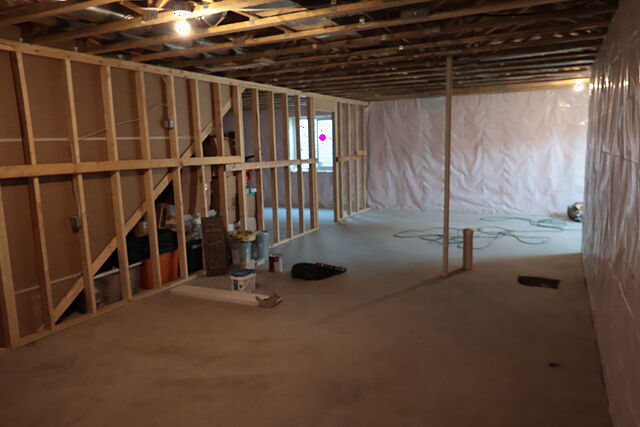
Finishing a basement puts insulation, framing, and drywall directly over the walls you would need to see to catch movement or water. Cover a crack that is still moving and you find out later, through a stain or a crack in new drywall, and the fix then includes tearing out the finish. So the foundation questions come first: is anything moving, does any wall leak, is the outside grading sending water at it, and will a new egress opening go into sound wall. The rest of that pre-finish checklist, moisture, egress, and what to look at before framing, is in our guide on what to check before finishing a basement.
Start with a walkthrough and a straight answer
Bring your dated marks, your photos, and your list of doors and rooms. Jace will walk the house with you, tell you what he sees and what he thinks is causing it, and say whether it is drainage, framing and footings we repair, or a wall that belongs to a specialty trade or an engineer. If it is our work, you get a written estimate with the scope spelled out. Call or text (605) 679-5223 to set up the walkthrough.

