Guide
What Actually Drives Deck Cost
Three quotes, three numbers, and none of them match. Here is what actually moves the price of a deck, and what to ask so you can compare bids fairly.
5.0 across 25 Google reviews · Licensed & insured · BBB Accredited, rated A · TimberTech PRO Gold contractor

Call three deck builders in Sioux Falls and you will get three different numbers. That does not automatically mean one is padding and one is cutting corners. Usually it means you got quotes on three different decks. Same footprint, same view out the back door, different structure underneath and different material on top.
There are no prices on this page. Material costs move, your yard is not your neighbor's yard, and any number printed here would be wrong by the time you read it. What does not move is the list of decisions that drives the number: height off the ground, footings, how the frame attaches to the house, decking, railing, stairs, site access, and permits. Learn that list and you can set two bids side by side and see exactly where they split.

Footings: depth, count, and who decided
Footings are the part you never see and the part that decides whether the deck is still level years from now. In South Dakota, freeze-thaw is the reason this matters: water in the soil expands when it freezes and lifts whatever sits above the frost line, so footings go below it. The required depth is set by the building department with jurisdiction over your address, and you should confirm it with them rather than trust a number off a contractor's website, including ours. Count is the other half. How many holes you need falls out of beam size and joist span: a larger beam carries farther and needs fewer posts, a smaller one needs more. Two bidders can both be right and land on different counts. What is not equal is a quote that never states depth or count. Digging conditions matter too: a machine that can reach the holes is one price, hand-digging or a hole that hits an old footing or a utility is another.

Ledger-attached or free-standing
An attached deck hangs off the house on a ledger board fastened to the rim joist. Done right, that means pulling siding, flashing the ledger so water cannot get behind it, and verifying what is back there before anything gets bolted to it. Sometimes it will not take the load. Brick or stone veneer, a cantilevered floor, thick foam sheathing, or rot at the rim joist all point the same direction: build it free-standing. That adds a beam, a row of posts, a row of footings, and bracing for lateral movement. Real money, and it shows up nowhere in the finished photo. If one quote is noticeably lower, look here first. Framing is core work for us, so if we open siding and find damage at the rim joist or sill plate, we tell you what we found and price that repair separately.

Decking material, and what hides behind the word composite
Pressure-treated pine, cedar, composite, and PVC are not one decision, and composite alone spans several tiers with different warranties. The category name tells you almost nothing. Board length and layout ride along with it: a deck a few inches longer than a standard board forces a seam plan or a lot of waste. So does fastening, since face-screwed boards and hidden clip systems differ in parts and labor. Extras like a picture-frame border or a diagonal run need more framing and blocking underneath, which is joist work, not decking work. Ask every bidder for the product line and color in writing.
Railing, stairs, and landings are their own projects
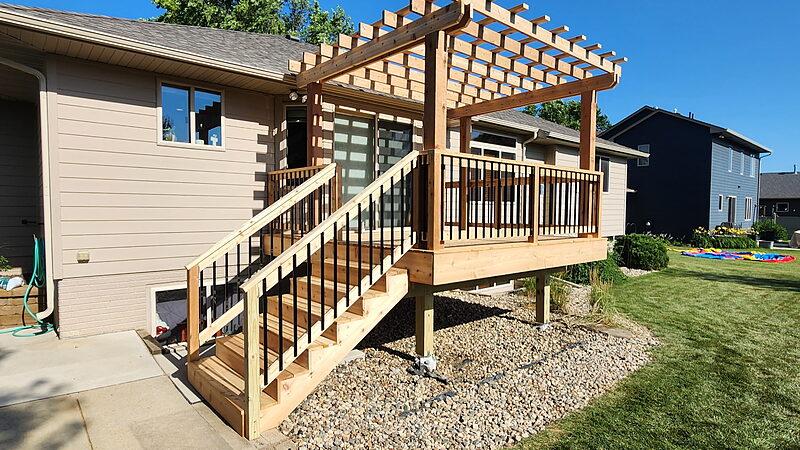
Railing is often one of the largest single line items on a deck, and the one homeowners most often assume is included. Cable, aluminum, composite, and wood systems differ in post spacing, blocking inside the frame, and install labor. Stairs are their own build: stringers, treads, guards where required, and a graspable handrail, all of it changing with how many risers your grade demands. Then the stairs have to land on something solid, and a concrete pad is its own line, with its own prep and cost. A quote listing stairs without saying how many, where they land, and what they land on is not comparable to one that spells it out.

Want this worked out for your own build? Jace writes the estimate on site — no call center, no obligation.
Site access and what is already in the ground
The same deck costs more on a hard lot. Can a machine reach the backyard, or is there a gate, a slope, a retaining wall, an air conditioner, or landscaping in the way? Every yard of dirt and every board carried by hand is labor. Utility locates happen before anything gets dug, and they can move where footings go. If there is an existing deck, tear-out and disposal is real work with real dump fees. Ask whether demolition and haul-off is in the number, and what happens if something unexpected turns up once the holes are open. Some builders price the unknown into the bid; some price the best case and change-order later. Both are legitimate, but you should know which one you are holding.
Permits, inspections, and who is licensed to pull them
South Dakota does not issue a statewide general contractor license, so the word licensed means different things depending on who is saying it. The City of Sioux Falls does license residential building contractors, and earning it requires passing a Construction Supervisor Examination and carrying a compliance bond and general liability coverage. Hols & Co holds City of Sioux Falls Residential Building Contractor license number 15868, held by Jace Jones, and sits on the city's approved Bonded Right-of-Way contractor list, which is an approval to work in the right-of-way, not a second license. More on that is on our licensed general contractor page. Permits cost money, and inspections run on the jurisdiction's schedule rather than the builder's. A quote with the permit included and a quote that leaves it to the homeowner are not the same quote, even when the totals look close.
Why two honest quotes for the same deck still differ
Put the differences in one place and the gap stops feeling mysterious. One bidder measured a height that triggers guardrail and one did not. One assumed a ledger, one is going free-standing. One priced an entry-level board, one a premium capped board. One included the stair landing, the permit, and hauling the old deck away. Any one of those moves a bid, and three or four stacked together explains most gaps. Before you read anything into the totals, make the scopes match.

What a written estimate from Hols contains
We write estimates so they can be compared against anyone else's. Conceptually, ours covers the scope in plain language, including size and shape; how the frame attaches, ledger or free-standing; footing depth to your jurisdiction's requirement, and how many; beam and joist sizing; decking named by product line and color rather than by category; the railing system named the same way; stairs described by count, direction, and what they land on; whether demolition and disposal is included; who pulls the permit and schedules inspections; and the site conditions we observed, including what could change once we are digging. Exclusions are listed rather than implied. Plumbing and electrical are subcontracted to licensed partner trades, so a circuit for a hot tub is coordinated work, not a line buried in the deck price. Where a number is an allowance rather than a fixed price, it says so. Jace has a Construction Management degree and does the walkthrough and the estimate himself, so the person explaining the number is the person answering for it later. See how we approach deck building in Sioux Falls.
Questions that make quotes comparable
Take the same list to every bidder, in the same order. What height did you measure to, and is guardrail included? How deep are the footings, and how many? Is the deck attached to the house or free-standing, and why that one? What decking product line and color? What railing system? How many stairs, where do they land, and on what? Is demolition and disposal included? Who pulls the permit? What is excluded, and what is an allowance? What happens if you hit something in the ground? You need those answers in writing before you sign. If you want a quote you can read line by line, Jace will walk the yard with you at (605) 679-5223.


