Guide
What Actually Drives Siding Cost
Three quotes to re-side the same house, three numbers. Here is what moves the price of siding, and what to ask so you can set the bids side by side.
5.0 across 26 Google reviews · Licensed & insured · BBB Accredited, rated A · TimberTech PRO Gold contractor

Ask three siding contractors around Sioux Falls to price the same house and you will get three numbers that do not match. More often you were quoted three different jobs: one strips the walls to the sheathing and one goes over what is there, one includes the trim package and one leaves it as existing, one priced a factory-finished board and one a primed board with the painting still to come.
There are no prices on this page. Material pricing moves, your house is not your neighbor's house, and any number printed here would be wrong by the time you read it. What does not move is the list of decisions that sets the number: the material family, whole house or one elevation, what comes off and what is found underneath, the shape of the walls, the trim and corners, the flashing at every opening, the season, and the permit. If a storm is the reason you are reading, our guide to siding hail and wind damage covers reading the walls first. This page is about what moves the number once you have decided to re-side.
The material family sets the crew, the cut, and the finish
Vinyl, fiber cement, engineered wood, steel, PVC, and cedar are not six prices for the same job. They are six different jobs. Vinyl is light, cuts with snips, and hangs loose so it can move with temperature. Fiber cement is heavy, cuts with a saw and dust control, takes more fasteners, and arrives either factory-finished or primed for a painter to finish on site. Engineered wood wants every cut edge sealed, steel asks for a careful hand at corners, PVC cuts like wood without taking on water, and cedar asks for the most upkeep over its life.
The lines we sell and install are James Hardie fiber cement siding, trim, soffit and backer, and AZEK PVC trim, siding and moulding. Whatever is on the quote, make every bidder name the product line, the profile, and whether the finish is applied at the factory or on your wall. The word siding by itself tells you almost nothing.
| Material | How it is finished | What the install asks for | What tends to move its number |
|---|---|---|---|
| Vinyl | Color through the panel | Light panels hung loose to move with temperature | Profile and thickness, trim package, cold-weather scheduling |
| Fiber cement | Factory color, or primed for site painting | Heavy boards, saw cuts with dust control, more fasteners | Finish choice, trim package, two-story work |
| Engineered wood | Factory color, or primed | Lighter than fiber cement, every cut edge sealed | Finish choice, trim, corner details |
| Steel | Factory coating | Sheared panels, careful corner and trim work | Panel profile, trim pieces, access |
| PVC | Color through, or painted | Cuts and fastens like wood, does not take on water | Trim, moulding, and corner pieces add up |
| Cedar | Stained or painted on site | Natural boards, sealed cuts, a painter after the carpenter | Grade of board, finishing, future upkeep |
Whole house, or one or two elevations
A full re-side and a single damaged elevation are different jobs, and the math does not scale the way people expect. A whole house gets one setup, one material order, one trim package, and one crew working around the building in sequence. One elevation still needs the setup, the order, and the trim, so a small job carries a bigger share of fixed effort. It also has to match. Profiles get discontinued, factory colors change, and the siding on your house has faded, so a new wall beside an old one can read as a patch even in the same product.
The honest answers are to run the new material to an inside corner, to choose a complementary color on purpose, or to repaint the painted walls so they meet. Each is a decision with a cost attached. Ask how the edges will be handled before you compare the numbers.
Tear-off: the layers coming off, and what is under them
Old siding has to go somewhere, and what is under it decides more than the material you chose. Some houses carry one layer. Others carry vinyl over steel over the original wood, and every layer is more labor to strip and more weight to haul, with real dump fees. A quote that goes over the existing siding skips that labor and that fee, and it also skips the only look anyone will get at the sheathing for a long time.
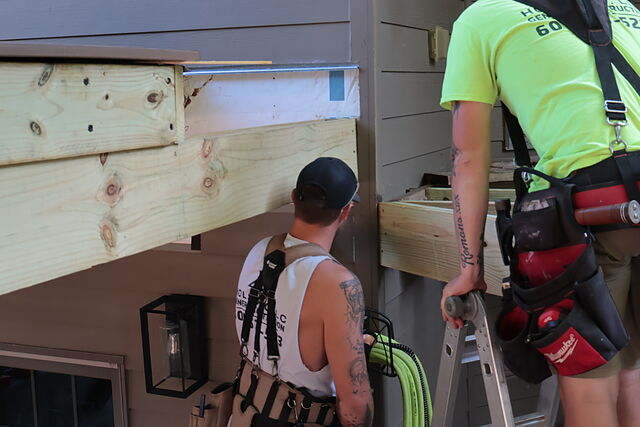
With the walls open, you find out whether the house wrap is continuous, whether the sheathing is dry, and whether the flashing at the windows and the deck ledger ever existed. Rot at a sill or a rim joist wet behind an unflashed ledger is not siding work. It is framing, which is core work for us, so we price that repair separately instead of burying it in the siding number. Ask every bidder what happens to the price if the sheathing is bad.
The shape of the house and how the crew reaches the walls
Two houses with the same floor plan can be very different siding jobs. A single-story ranch with four plain walls is cut, carried, and hung from the ground. A two-story with gables, dormers, a bump-out, and a dozen outside corners has more edges to cut, more trim to wrap, and all of it done off ladders, scaffold, or a lift. Every corner means a trim piece and two fitted ends.
Then there is reaching the wall. Shrubs against the foundation, an air conditioner on a pad, a narrow side yard, or a steep grade all change how the crew works. A deck built tight to the house is the common one: the siding behind the ledger cannot come off without part of the deck coming apart, and that is a decision to make before the bid, not after. Count your corners, gables, and obstacles, then ask whether each quote assumed the same ones.
Trim, soffit, fascia, and corners are their own package
The trim package can rival the siding itself, and it is the part that varies most between quotes. Every window and door gets trim. Every outside corner gets a corner board or a corner post. The band between stories, the frieze under the eave, the soffit and fascia at the roofline: each is a line item, and each is either in the number or it is not. A blocked corner uses a thick board the siding butts into; a mitered corner cuts the siding to meet itself, which takes more fitting and more skill.
We use James Hardie trim and soffit and AZEK trim and moulding, and the estimate lists trim by location. When one quote is noticeably lower, look here second, after the tear-off. The siding may be the same product while the trim is a thinner profile or left as existing, and old trim rotten at the foot of a corner will show against new siding.
Want this worked out for your own build? Jace writes the estimate on site — no call center, no obligation.
House wrap, flashing, and every opening
Water does not get into a wall through the middle of a panel. It gets in at the openings and the joints, so the water management under the siding is where the labor hides. The wall goes back together with house wrap that is continuous and lapped so water runs out rather than in, tied into flashing at every window head and sill, every door, and the deck ledger. Where a roof runs into a sidewall, the flashing at the bottom of that run needs a kick-out that throws water away from the wall. Foam sheathing, if the plan calls for it, changes how everything fastens and belongs in the quote from the start.
Windows and doors are the scope decision to settle before material is ordered. If windows are being replaced, they go in before the siding, and whoever does that work belongs in the schedule. Re-siding around windows you plan to replace soon means doing the trim and flashing twice.
Season, scheduling, and the permit
The building season here is short, and some materials should not go on in hard cold. Vinyl gets brittle and cracks when it is cut or nailed cold, and it has to be hung with room to move as it warms. Caulks, paints, and sealants carry minimum application temperatures on the label, and the manufacturer's installation instructions set the conditions for each product. Ask when the work would actually start, not only how long the estimate is good for.
Whether a siding job needs a permit is set by the building department for your address, and the Sioux Empire is not one jurisdiction. When it does, we file it in our name and schedule the inspections, which our licensed general contractor page explains. A quote with the permit inside it and a quote that leaves it to you are not the same quote, even when the totals look close.
Why two honest quotes for the same house still differ
Put the differences in one place and the gap stops feeling mysterious. One bidder priced tear-off to the sheathing and one is going over the old siding. One included the trim, soffit, and corners and one left them as existing. One priced a factory-finished board and one priced a primed board with the painting as somebody else's problem. One assumed the deck comes apart and goes back together; one never looked behind it. One wrapped and flashed every opening and one is reusing what is there. Any one of those moves a bid, and three or four stacked together explains most gaps. Before you read anything into the totals, make the scopes match.
What a written estimate from Hols contains
We write estimates so they can be compared against anyone else's. Ours describes the scope by elevation: which walls, whether the old siding comes off and how many layers, and what gets hauled away. It names the siding by product line, profile, and color rather than by category, and the trim, soffit, fascia, and corners the same way, by location. It says how the openings are wrapped and flashed and what happens at the deck ledger and any roof-to-wall joint. It states who pulls the permit and schedules inspections, and lists the site conditions we observed. Exclusions are listed rather than implied, and where a number is an allowance rather than a fixed price, it says so. Jace has a Construction Management degree and walks the exterior and writes the estimate himself, so the person explaining the number is the person answering for it later. Project financing is available on qualifying jobs.
Questions that make quotes comparable
Take the same list to every bidder, in the same order. Is the old siding coming off, and how many layers do you expect? What happens to the price if the sheathing behind it is bad? What product line, profile, and color, and is the finish from the factory or painted on site? Is the trim package included, and what does it cover? How are the openings being flashed, and what is the plan at the deck ledger? Is the house wrap new or reused? Who pulls the permit? What is excluded, and what is an allowance? You need those answers in writing before you sign. If you want a quote you can read line by line, Jace will walk the house with you at (605) 679-5223.


